
How to get your car ready for every season: heat, cold, rain and dust
Heat, cold, rain and dust each ask something different of a car, so this guide takes them one at a time, with what changes, what to check and where your car's own figure is.

Published
You are at the entrance of this guide. Wherever you drive, a car meets four conditions through the year: heat, cold, rain and dust. The guide takes them one level at a time, then closes with a check before a long journey and a map of your car’s own figures.
Every range here is typical. Your car’s manual gives the figure for your car, and it has the last word.
Start with the conditions, not the calendar
This first level shows how the guide is laid out, and it leads you to the four conditions. A season means different things in different places: a cold winter, a hot dry season, months of rain or weeks of dust. Your car does not follow the calendar. It reacts to temperature, water and dust, and six places on it react most.
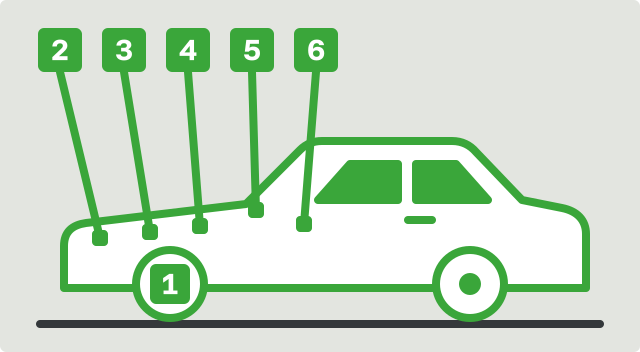
- Tyres: heat, cold and rain.
- Battery: heat and cold.
- Coolant tank: heat and cold.
- Engine air filter: dust.
- Wipers and washer: cold, rain and dust.
- Cabin air filter: heat, rain and dust.
Go to the level for the condition ahead of you: it says what changes, what to check and where your figure is.
Heat
You have reached heat, the first condition; its effects are slow and easy to miss, and the next level, cold, is where they show.
Tyre pressure
Air expands as it warms: a tyre’s pressure typically rises by about 0.1 bar (1.5 psi) for every 10 °C (18 °F), by one tyre maker’s figure. That is why you measure with cold tyres, parked for about three hours or driven only a very short distance. If the tyres are warm, do not let air out to reach the figure; measure again when they are cold. A tyre with too little air flexes more, builds up heat and wears faster.
Coolant
Coolant carries heat away from the engine and protects it against frost and corrosion. With the engine cold, the level sits between the two marks on the expansion tank. Top up only with the type your manual names, because makers advise against mixing types. A level that keeps falling is work for a workshop.
Battery
A car battery works best at about 20 °C (68 °F). In heat it discharges itself and ages faster: by one battery maker’s rule of thumb, its chemical activity doubles for every 10 °C rise. Have it tested at a workshop once a year, before the cold arrives.
Cabin, oil and shade
Change the cabin air filter on your manual’s interval; one parts maker advises every service, or at least every six months. A few minutes before you arrive, switch the cooling off and leave the fan on, so the ducts dry. Cooling that has grown weak is work for a workshop. In an oil grade such as 5W-30, the second number describes the oil at working temperature; use a grade your manual lists. Winter tyres wear much faster on warm roads. Parking in shade keeps the cabin and the dashboard cooler.
Cold
Cold is the second condition and the place where the heat’s slow wear shows; it changes the battery, the tyres and the fluids at once, and it leads on to rain.
Battery
Cold slows a battery’s chemistry. Taking 20 °C as full activity, the same maker puts it at about half at 10 °C and a quarter at 0 °C. A reference work on batteries puts a battery’s capacity at −18 °C (0 °F) at typically about half of its capacity at 27 °C (80 °F); it returns as the battery warms. Meanwhile, a cold engine asks more of it.
Slow cranking and dimming headlights are signs of a low charge, and short trips leave the battery only partly charged. Keep the terminals clean and dry. If the battery does not start the car, your manual gives the procedure for your model; otherwise it is work for a workshop. In an electric car, the cold shortens the distance a charge covers until warmer weather returns.
Tyre pressure
Pressure falls by typically 0.07 to 0.14 bar (1 to 2 psi) for every 10 °C, by another tyre maker’s figure. By the first maker’s figure, a tyre also loses about 0.07 bar a month on its own. While the temperature is falling, check about every two weeks, with cold tyres, even if your car has a pressure monitoring system.

| Outside temperature | Tyre maker’s rule of thumb | Calculated from the gas law |
|---|---|---|
| 40 °C (104 °F) | 2.54 to 2.68 bar | 2.63 bar (38.2 psi) |
| 30 °C (86 °F) | 2.47 to 2.54 bar | 2.52 bar (36.5 psi) |
| 20 °C (68 °F), when set | 2.40 bar | 2.40 bar (34.8 psi) |
| 10 °C (50 °F) | 2.26 to 2.33 bar | 2.28 bar (33.1 psi) |
| 0 °C (32 °F) | 2.12 to 2.26 bar | 2.17 bar (31.4 psi) |
| −10 °C (14 °F) | 1.98 to 2.19 bar | 2.05 bar (29.7 psi) |
| −20 °C (−4 °F) | 1.84 to 2.12 bar | 1.93 bar (28.1 psi) |
Tyre types
A summer tyre’s rubber hardens in the cold. A winter tyre’s softer compound stays flexible, and an all-season tyre sits between the two and suits mild winters.
Coolant
The coolant mix also keeps the cooling system from freezing. Half concentrate and half water is the usual mix unless your manual says otherwise, and one maker’s data sheet gives 33 to 60 percent concentrate as its working range. Never run the system on water alone or on pure concentrate. A workshop can measure the strength of your mix.

Oil, washer and wipers
The number before the W in an oil grade describes the oil in the cold: a lower number flows more easily at a cold start. As temperatures start to drop, use winter washer fluid in the proportion on its label. On frosty nights, lift the wiper blades off the glass. Never run the wipers on a frozen windscreen: clear the ice first with a plastic scraper.
Rain
Rain is the third condition, and it means water under the tyres and water on the glass, before the route moves on to dust.
Tread
The grooves carry water out from under the tyre, and they carry less as the tread wears. Find the tread wear indicators, small raised bars in the main grooves: when the tread is level with them, the tyre is replaced. Before then, measure with a tread depth gauge in several places and go by the lowest reading. Uneven wear points to the pressure or the wheel alignment; a workshop can check the alignment.
Wipers, glass and lights
The wiping pattern shows the state of the blades. Clean the rubber with a moist cloth, and change the blades at least once a year, ideally before and after the cold season.
| What you see on the glass | What it means |
|---|---|
| No streaks, or up to 3 thin streaks at the edge | The blades are fine |
| One lasting streak in the centre, or 4 to 5 at the edge | Replace the blades soon |
| A fogged film, or marks where the blade skips | Replace the blades now |
A fresh cabin air filter helps the windows clear quickly. Walk round the car to see that every lamp works, and clear leaves from the base of the windscreen so the wipers and the water channels stay free.
Dust
Dust is the fourth condition, the one of dry seasons and unpaved roads, and from here the route leads to a check before a long journey.
Filters
The engine air filter keeps dust out of the engine. In dusty conditions or off the road, it is changed earlier than usual; many manuals give a shorter interval for dusty use. A loaded filter can reduce performance and raise fuel use. Do not blow a paper filter clean with compressed air: that pushes particles deeper and can tear the paper. Change the cabin air filter sooner in a dusty season too.
Glass, paint and seals
Never wipe dry, dusty glass: wet it with the washer first, remove coarse dirt by hand, and keep the washer tank full. Rinse dust off the paint with plenty of water before a cloth touches it. A workshop cleans dust and insects off the radiator at a service. Wipe the door seals with a damp cloth so the doors close cleanly.
| Condition | What it changes | What to check | When (typical) |
|---|---|---|---|
| Heat | Pressure rises; the battery ages faster | Pressure, coolant, cabin filter, battery | Pressure every 2 to 4 weeks; battery test yearly |
| Cold | Pressure falls; the battery gives less | Pressure, battery, coolant, washer fluid, blades | Pressure every 2 weeks as it gets colder |
| Rain | Water under the tyres and on the glass | Tread, blades, washer, lights | Blades at least once a year |
| Dust | Filters load up; grit scratches | Both air filters, washer | The manual’s interval for dusty use |
| A long journey | Load, and more than one condition | The six checks below | Before you leave |
Before a long journey, in any season
You are almost at the exit: this level turns the four conditions into six checks for a journey, before the last level points to your car’s own figures.
- Tyre pressure, cold, at the manual’s figure for your load; the spare too.
- Tread and sidewalls: indicators not reached, no cuts or bulges.
- Fluids: oil and coolant levels with the engine cold, and washer fluid for the temperatures on the way.
- Wipers and lights: a clean wiping pattern, every lamp working.
- Battery: tested within the last year if the route is cold.
- The route: mountains add cold, and a dry plain adds heat and dust. Go back to that level.
Where your car’s own figures are
This is the last level, and it leads from the typical ranges above to the figures that belong to your car.
- Your car’s manual
- Pressures, oil grades, the coolant type and service intervals, including any for dusty use.
- The tyre-pressure label
- On the driver’s door frame or inside the fuel filler flap: pressures for cold tyres, also for a loaded car.
- A fluid’s label
- The mix and the temperatures it is made for.
- A workshop
- Everything this guide names as work for a workshop.
Every figure here comes from a source below. You can read how Vindalho checks its guides in its editorial policy.
Sources
- Continental Tires, Tire pressure in winter, seen 16 November 2026.
- Continental Tires, Tire pressure, seen 16 November 2026.
- Continental Tires, Tire tread, seen 16 November 2026.
- Michelin, What tyre pressure, updated 2 December 2025.
- Clarios, The temperature’s effect on batteries, seen 16 November 2026.
- Battery University, BU-502: Discharging at high and low temperatures, updated 27 October 2021.
- BASF, Technical information for an engine coolant concentrate, data sheet of April 2022.
- MS Motorservice, Air filter replacement, seen 16 November 2026.
- MS Motorservice, Coolant mixing ratio, seen 16 November 2026.
- Bosch, Tips and tricks for windshield cleaning, fact sheet of August 2024.
- Bosch, Clear view: tips and tricks concerning the maintenance of wiper blades, February 2020.
- Mobil, Explaining viscosity designations, seen 16 November 2026.
- MAHLE, So cool and so fresh…?, updated 23 January 2022.
- OpenStax, College Physics 2e, 13.3 The ideal gas law, 13 July 2022.